Why Enterprise AI Is Entering the Control-Plane Era
Recent Microsoft, Google and Rockwell developments show enterprise AI becoming an operating layer. The advantage will come from governed automation grounded in business workflows—not models alone.

Recent Microsoft, Google and Rockwell developments show enterprise AI becoming an operating layer. The advantage will come from governed automation grounded in business workflows—not models alone.
Enterprise AI is moving beyond isolated chatbots. The next competitive layer is the control plane around the model: the identity, permissions, operational context, monitoring and human escalation that determine what an AI system can do inside a business.
That shift is visible in several announcements published this week. Microsoft is positioning Agent 365 as a common management layer for discovering, governing and securing agents. Google is putting agent controls and stronger device identity into Android Enterprise. On the factory floor, Rockwell Automation is showing why business-specific knowledge matters more than a generic assistant. Together, these developments point to a practical conclusion: companies will create durable value from AI only when automation is manageable, observable and grounded in the work itself.
Microsoft says Agent 365 will provide a registry for Microsoft-built, third-party and custom agents, alongside policies for onboarding, access, lifecycle management and audit trails. The important idea is broader than one product. Once a company has dozens or hundreds of agents, knowing which agents exist, who owns them and what data they can reach becomes an operational requirement.
Google’s September 23 Android Enterprise update makes the same point at the device layer. Google says administrators will be able to configure or disable AI automation across managed fleets, while work-profile separation is designed to prevent personal agents from entering corporate apps and data. Planned attestable identifiers would let management systems cryptographically verify device identity before granting access.
These controls are not administrative overhead added after deployment. They are part of the product architecture. An agent that can read email, open files or take action across applications needs a narrower identity than the employee it assists, a clear owner and a record of what it changed.
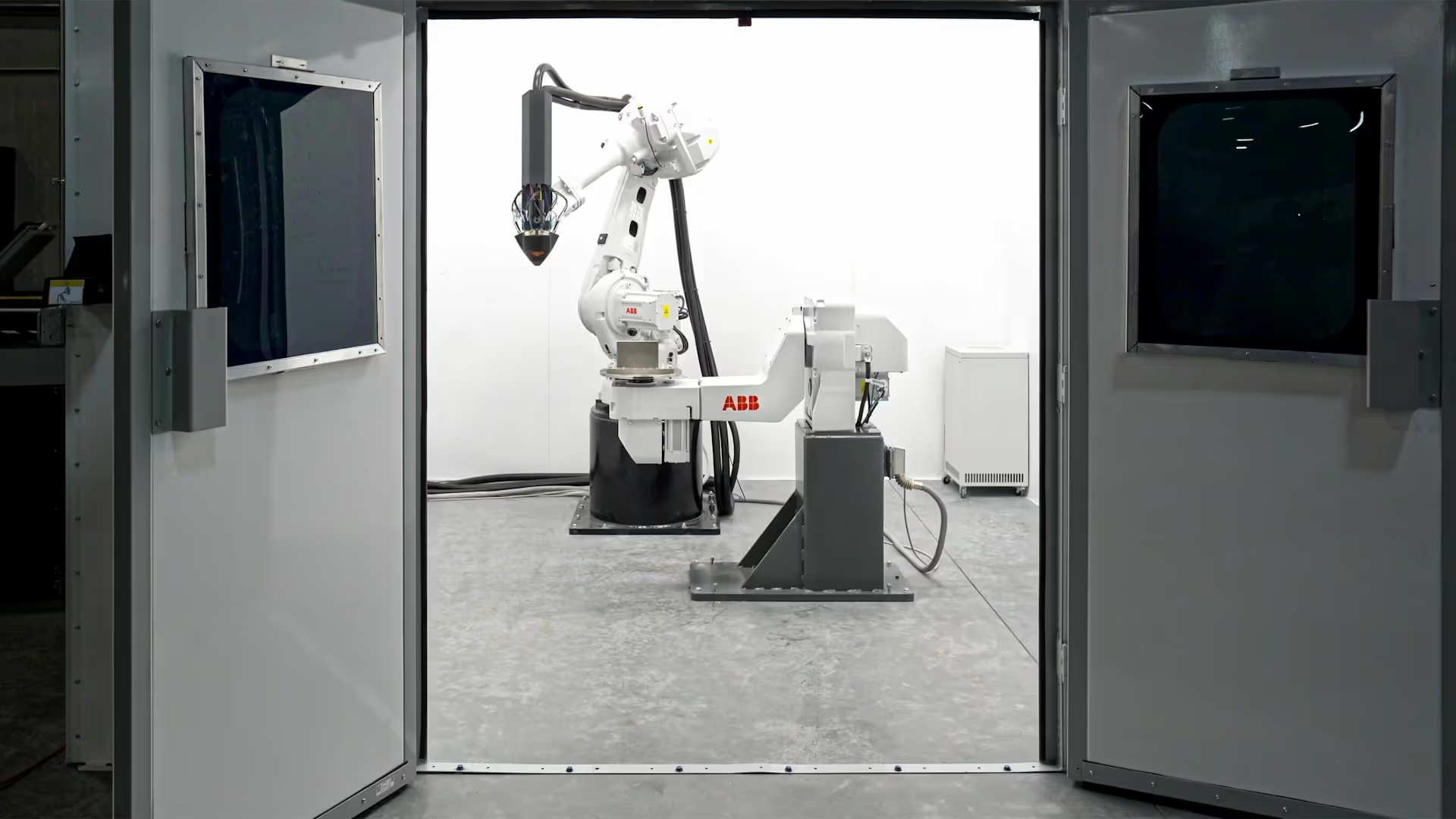
A recent Rockwell Automation case study illustrates why context matters. At its Singapore facility, Rockwell built a maintenance assistant around machine manuals, manufacturing data and knowledge contributed by experienced engineers. Technicians can search likely causes of an equipment error and retrieve structured troubleshooting steps instead of manually scanning documentation or locating a senior colleague.
Rockwell reports that the system has helped lower machine downtime by 33 percent and servicing and spare-parts costs by roughly 25 percent. It also estimates that new-worker troubleshooting readiness has fallen from nine months to three. Those figures are company-reported, but the deployment pattern is instructive: start with a bounded workflow, combine documented knowledge with expert experience, and measure an operational result that managers already understand.
The lesson is that a general-purpose model is rarely the defensible asset. The harder work is preparing trusted information, defining the decision boundary and connecting the system to a specific workflow without giving it unnecessary authority.
NIST’s August 2026 Cyber AI Profile workshop report highlights governance challenges, expanding AI attack surfaces, inconsistent terminology and the need for risk-based implementation guidance. That is a useful counterweight to product announcements: enterprise controls cannot depend only on what a platform vendor exposes.
Companies need a cross-platform record of agents and AI-enabled applications, including their purpose, owner, data sources, credentials, downstream actions and review history. Risk should be reassessed when a model changes, a new integration is added or an agent moves from recommending an action to executing it.
First, create an inventory before expanding deployment. Each system should have a business owner, a technical owner and a defined outcome. Second, give agents their own identities and least-privilege access rather than allowing them to inherit broad user permissions. Third, log inputs, retrieved sources, tool calls, approvals and resulting changes in a form that security and business teams can review.
Fourth, design the human handoff. High-impact actions should pause when confidence is low, data conflicts or the requested action crosses a financial, legal, safety or privacy threshold. Finally, measure the workflow rather than the novelty: time saved, error rates, downtime, cost per completed task and the frequency of human corrections are more useful than conversation counts.
The next phase of enterprise AI will not be won by deploying the largest number of assistants. It will be won by organizations that can make automated work visible, bounded and repeatable. Models will continue to change quickly. A strong control plane allows the business to adopt better models without rebuilding accountability every time.
Illustrative photograph: Brett Sayles / Pexels, used under the Pexels license.

Join industry leaders and innovators who rely on us for exclusive insights, interviews, and trends shaping the future of business and tech — straight to your inbox.